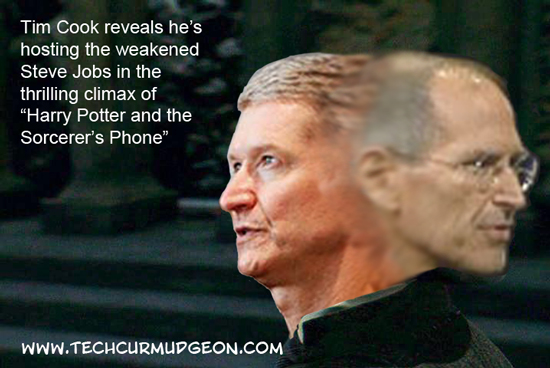
It’s not too early to begin discussing the round of new products to be unveiled at Apple’s next media
circus event. Apart from a new set of incrementally improved iPhones, iPads, iPods and Macs, the world’s attention is likely to focus on the revolutionary new Apple Thumbtack!1
The Apple Thumbtack, as you might imagine, is designed to join multiple documents. In keeping with the new 3D pressure sensitivity, a light
press of the Apple Thumbtack creates a document collection. A heavier press creates a merged document containing the combined contents of
all the individual documents. And the heaviest press creates a hole in your screen.
Apple may take some flack for this reversal of Steve Jobs’ well known view that “if you have to use a thumbtack, they blew it.” Still, it’s
been acknowledged the thumbtack has been on Apple’s Chair, Art Levinson’s mind for a while.
1Our sources inform us that Apple Paperclip was rejected as being too similar to Microsoft’s Office Assistant, and Apple Staple just
sounded stupid.
My Android phone had to beg and plead
To be upgraded to Lollipop.
This upgrade really has nothing I need
But it did make my Clock app just stop.
Tech entrepreneurs become billionaires
Selling products at which we all curse.
They go on making money ‘cause nobody dares
Point out these things could scarcely be worse.
Everyone hates Tim Cook and Bill Gates
Yet we keep buying stuff from these thugs,
In spite of the need for constant updates
Just to fix the last update’s bugs.
We care more about toasters than about toast,
Buying products that flew or just flopped.
I’d issue a wake up call right in this post,
But unfortunately, Clock app has stopped.
Apple has now become the most valuable public company in history. No
doubt this is largely due to their seemingly endless stream of
life-altering, or at least culture-altering, gadgets. Think about it
... the Macintosh, the Newton (ok, low blow), the iPod, the iPhone, the
iPad, the iDon'tKnowWhatButThereMustBeSomethingElse.
But in all this, it's easy to lose sight of what are really the most
significant inventions of all time. Therefore, as a public service, we
provide this reminder.
5)
computers
In addition to letting us expose every aspect of our personal lives to friends and advertisers alike1, the computer has revolutionized just about every other product on earth. It is also responsible for getting millions of indigent nerds off the streets and into productive jobs.
4)
hair coloring
I don't know, but my wife insists this is essential.
Interior, tastefully furnished law office with glass-walled conference rooms, private offices and desks in the open area. Plants and muted artworks adorn the walls. A well dressed bloated gentleman, who vaguely resembles Captain Kirk from "Star Trek", is talking with a somewhat younger bloated gentleman who vaguely resembles the young guy from "Sex, Lies and Videotape."
KIRK-LIKE GUY: We'll have to go outside the firm for this one.
SLV-LIKE GUY: Sir?
KIRK: We need all the best legal minds in the country. Money is no object.
SLV: Seriously?
KIRK: Well, ok we'll try Priceline first.
SLV: Ok. I just hope this is going to be worth it.
KIRK: Are you kidding? It's a gold mine.
ACT ONE
Interior, glass-walled conference room. The walls are completely hidden by stacks of bankers boxes. More boxes are stacked on the conference table, amid piles of papers.
Around the table are ALICIA FLORICK, FRANKLIN and BASH, BOBBY DONNELL and ASSOCIATES, MCKENZIE, BRACKMAN, CHANEY and KUZAK, MATLOCK, CLINTON JUDD, PERRY MASON and A WOMAN WHO LOOKS VAGUELY LIKE CHARLIE MCCARTHY'S LITTLE SISTER. They are all occupied with reading files and documents.
Every so often, one of them flips a page, or turns a document sideways as if to examine a diagram, or clears his or her throat.
ACT TWO
Same.
ACT THREE
Ditto.
ACT FOUR
Likewise.
TAG
KIRK and SEX-LIES-VIDEOTAPES GUY are sitting on a balcony, smoking big, fat stogies.
KIRK: Well, I guess we're ready for that Apple v Samsung case now!
SLV-GUY: Are we?
KIRK: Who the hell knows? Let's just chuckle and enjoy our stogies like we always do.
There are basically three ways that technology companies develop and maintain their “vision” of the future:
Let engineering drive.
Use marketing/product management to gather requirements, feedback, etc.
Have an all-knowing dictator.
The first approach tends to produce incremental improvements of the same basic products. The engineers all know how to improve what they’re already building, but not necessarily how to completely blow it away. Many such companies tend to engineer themselves into oblivion. Anybody remember DEC?
The information gathering approach is probably the most widely espoused (if not necessarily used). Theoretically, this leads to building what customers want, but the results tend to be very conservative. Customers don’t necessarily know what they want, and modest proposals achieve consensus much more easily than radical new ideas. Some companies start out being very innovative, and then settle into this how-can-we-help-you model. I suspect Google, the king of Web analytics, fits this category.
The all-knowing dictator model, at least as exemplified by Apple, is obviously very successful … if you have such a person. Pretty tough to pull off otherwise.
There’s actually another model: copy other successful companies. Microsoft has managed this, occasionally adding a bit of innovation, throughout its history. Windows came from Xerox (via Apple). C# was Java. Windows Phone was Windows Mobile was … whatever else they’ve called it … back to the original smart phones they copied from. XBOX was Nintendo or Sony or whoever’s gaming system.
Maybe there's yet another model to consider: crowd-sourcing. Just give everybody the tools to make their own cool things, and see what emerges. The mobile app industry may ... just may ... be going in that direction.
As we predicted, Apple's new iPad, known as the new iPad1, will be new. In particular, it will provide four (4) times as many display pixels as the previous model. Overall, the resolution of 2048 x 1536 means the device requires three million one hundred forty-five thousand seven hundred and twenty-eight (3,14 ... whatever) pixels. This could lead to a world-wide pixel shortage.
Currently Apple's chief manufacturer, Foxconn, is believed to have a supply of pixels sufficient to equip 20 or 30 million new iPads, far fewer than the expected sales this year. Researchers are now frantically trying to develop new pixel sources via mining and off-shore drilling. In particular, the controversial practice known as fracking may be adapted to produce pixels from naturally occurring shale. However, environmentalists fear that widespread fracking could lead to cave-ins in pixel-rich areas.
At today's new iPad announcement, Apple CEO Tim Cook, with his shirt un-tucked in a pathetic attempt to mimic the casual coolness of the late Steve Jobs, appeared unconcerned about possible pixel drought, fueling speculation that Apple has been cultivating techniques for producing synthetic pixels.
1How many years will they get out of that naming convention? Three, I suppose, if they use "newer" and "newest" for the next couple of models.
As the world anxiously awaits the release of Apple's latest blockbuster, iPad 3: The Empire Strikes Back, the rumor mills are churning out rumors about when the next rumors will be circulated. Followers of tech blogs know when to tune in to catch the latest update on anticipated processor speed, video resolution, and thickness to within a thousandth of a millimeter. The current wisdom is that the latest incarnation of Apple's wildly successful tablet will feature the high-resolution Retina display, an updated processor, possibly quad-core, and a V6 engine that gets 32mpg.
In other news, Apple is suing the crap out of smartphone makers HTC and Nokia, alleging infringement on its patent for "technology that seems really cool and irresistible, but that becomes boring and useless 12 months later."
Despite its financial difficulties, California is weighing opening several shelters for battered Siris whose owners have flung them across the room in response to dropped calls, roaming charges and other domestic disputes.
When I started as a computer professional, we used minicomputers. They were called "mini" because they were only as big as two or three refrigerators, and four times as noisy. They had to be installed in special climate-controlled rooms, with raised floors for all the cabling and air conditioning. We used to run what we called application programs.
Then the whole world went to personal computers. These could fit on a desk, with plenty of room left over for a pencil or a paper clip. The computers themselves weren't so big, but you needed room for boxes and boxes of floppy disks. And these disks contained applications. Not application programs. Just applications.
Now I carry the equivalent computer power in my pocket. One in each pocket, actually. We don't need floppies. Everything's in The Cloud. And those programs? Now they're just apps.
Next I suppose everything will be implanted surgically. The user interface will be just to think of what you want. Of course, it will be hard to drive with all the "Updates are available" messages popping up in our heads. But so what? They'll drive. There'll be an A for that.
In her 1969 book, On Death and Dying, Dr. Elizabeth Kübler-Ross describes the five stages of grief: denial, anger, bargaining, depression and finally acceptance. But when I heard the news of Steve Jobs's death yesterday, my first reaction was definitely anger. I had just come up with a decent bit of Steve Jobs-related humor, and spent at least several minutes tinkering in Photoshop to produce it. (See below.) Why couldn't he have waited a week?
But after further reflection, I realized something important. Really, The Tech Curmudgeon comes from many years of watching technology, especially computers and software, evolve and grow in importance. I've seen computers go from highly specialized equipment that requires climate-controlled rooms with raised floors to devices that many of us carry in our pockets.
Throughout this period, the vendors of technology have always been all too eager to sell us whatever gadget or innovation they can devise, with no regard for consequences. Ever gotten a spam email? Or a virus? Ever cursed at a gadget or piece of software for being too difficult to use, or too unreliable? Ever noticed that you spend more time maintaining your computer than you do using it? Technology vendors have always gone for the bells and whistles, rather than for the satisfying experience.
They just didn't get that computers are not mops or toasters or even coffee makers. We don't merely use computers. We have relationships with them. They're life partners!
But Steve Jobs got it. If he's known for anything, it's for the sheer elegance of Apple's products. The whole field of user experience design is illuminated by these products and the concept they realize of bringing joy, and not just utility, to the user. With the passing of Steve Jobs, the world has lost its greatest exponent of technology joy, and product joy in general.
Which means The Tech Curmudgeon will have a lot more material.
Ok, here's the somewhat lame and now thoroughly tasteless bit of humor ...
There's an old saying that you can recognize a pioneer by the arrows in his back. If the arrows had been in his front, you'd think the pioneer had taken risks and suffered the consequences. Arrows in the back, however, can only mean one thing: friendly fire. The pioneers have taken a beating at the hands of their own followers.
Think about it. How many of these products have you heard of? Used? Owned?
Xerox Star
Visicalc
WAIS
pen PC
AudioHighway Listen Up
WebCrawler
On the other hand, how familiar are these?
Apple Macintosh
Microsoft Excel
World Wide Web
Apple iPad
Apple iPod
Google
Each of these household words is really just a later version of some earlier product that's now extinct. Why have these derivative products and technologies had such a lasting effect, when the true originals disappeared? Did the imitators offer some vital improvement? Did they just do a better job of marketing? Did the public need time to assimilate the idea? Who knows? There's really only one lesson we can definitely take away from this...
Let's face it. Tim Cook is probably a very competent executive, but he's no Steve Jobs. Seriously, have you ever heard of anything he's done? He's not the the industry-shaking innovator that Apple needs.
I, on the other hand, have loads of ground-breaking ideas. And I can draw them! If that doesn't make me a visionary, I don't know what does. Here is just a handful of my game-changing innovations...
So let Apple know you think I should be the next CEO. And if you're on Apple's board, vote for me!
I heard there was a cool device
That needs no keyboards and no mice
And still it lets me send an email to you.
It costs about five hundred bucks,
But 16 Gig, no 3G sucks.
So drop eight hundred for your iPad 2, yeah.
It comes with a USB cord,
Buy a charger you can afford.
(You don't want to bring a laptop, do you?)
And if you are a gadget lover
You'll want to buy the new "smart cover"
To protect and defend your iPad 2, yeah.
iPad 2, yeah. iPad 2, yeah.
iPad 2, yeah. iPad 2, yeah.
Consider each accessory,
Adapters for your home TV,
A docking station with a keyboard too, yeah.
With all the stuff you'll want on hand
The total cost's about a grand
And worth each cent, 'cause Apple wouldn't screw you.
iPad 2, yeah. iPad 2, yeah.
iPad 2, yeah. iPad 2, yeah.
You did your best, but it wasn't much.
It's hard to browse on an iPod Touch.
The tiny on-screen keyboard overthrew you.
The cut-and-paste would make you swear
And want to pull out all your hair.
What you needed was to get an iPad 2, yeah.
Bill Gates is no longer at Microsoft. Google is run by a small team of unknown nerds. Even after being the subject of a hit movie, Mark Zuckerberg is not the "face" of Facebook.
But Steve Jobs IS Apple. It's hard to think of any individual executive so closely associated with his company's brand. (Jim Perdue definitely lacks his father's strangely charismatic blandness.) Even his alter-ego as Disney/Pixar Steve Jobs doesn't dilute his Apple appeal.
So when he's out on medical leave, people worry about the fate of Apple. To help ease the anxiety, I think it makes sense to publish a guide to being Steve Jobs, so someone else can step up and fill the role. To begin with, let's talk about the aspect of Steve Jobs that's probably most instrumental in Apple's success ... being a design-y guy. Apple's success hinges more on its product design than anything else, so let's start by explaining how to design an Apple product.
1) It can't look like a computer. Ideally, it should look like a piece of glass or a block of aluminum, but really, anything but a computer. A block of aluminum with a piece of glass in it is ok.
2) No controls! No buttons. No keyboards. No mouse. No stylus. Ok, if we absolutely have to have a keyboard or mouse, make it look like a piece of glass or aluminum.
3) No wires. Bluetooth. WiFi. 3G. But no stinkin' wires.
4) No Flash.
5) Cute. Must be cute. Things on screen should swell with pride when you go near them, and literally jump up and down when you touch them. UI is all done with colored jelly beans.
6) Did we mention no Flash?
7) No user serviceable parts. Not even a battery change.
8) No sharp edges or corners.
9) Make it any color, as long as it's black, white or silver.
10) These are today's rules. At some point, some other rules will be in. Then discard everything here, and follow those rules without mercy.
With these rules, soon you too will be able to run ads like this ...
So once again, there's shuffling and speculation about the health of Apple's Steve Jobs. He's taking his second medical leave of absence in two years, and the high tech world is abuzz with questions. Will he come back? Who could be his successor? Who can give Apple the kind of creative vision that Lady Gaga will undoubtedly bring to Polaroid? Is the world ready for a digital camera made of meat?
Since Polaroid, an imaging company, has signed Lady Gaga, at least nominally a musician, perhaps Apple, now partly a music company, should try to attract a visual artist. Steve Jobs, as the largest shareholder in Disney, should be able to pull this off. Might John Lasseter, writer of the Toy Story movies and director of 2/3 of them, be a good fit? Or Spider-man mogul Stan Lee? Or even Calvin & Hobbes creator Bill Watterson? It's about time we heard from him again.
Of course, the next head of Apple should be someone who's very creative, perhaps someone whose background includes both art and theater. Someone who understands technology, who holds an advanced technology degree and has worked for both hardware and software companies. Maybe an Apple outsider, who can bring a fresh perspective. Someone who can provide the maturity of experience, but who still thinks like a kid. Mainly, someone who has vision, and can communicate that vision.
It's now safe to make predictions for the year 2010. (Ok, so I'm not a big risk taker.) Here are my top ten:
In a stunning reversal, Republicans decide the Obama health care reform bill is the best legislation ever. The controversial provision requiring Americans to buy health insurance is seen as precedent-setting. The GOP immediately goes to work drafting laws that require Americans to buy cars, high-definition TVs, and real estate in Florida.
Apple rocks the world with the invention of a phone that not only doesn't fit in your pocket, but can't be used as a phone. They sell millions. In response, other phone makers develop Google Android devices that offer all of this plus a near complete lack of application software.
A group of Chilean miners invents a way to avoid campaign advertising. Rights are acquired by Disney, the reality-avoidance company, in exchange for E tickets.
BP invents a new way to harvest oil by drilling holes in the ocean floor and waiting for it to wash up on the beach, where it is collected by government workers and volunteers.
Economic woes cause world-wide hardship as millions of homes and jobs are lost, school budgets are slashed, and Republicans are forced to cut back on Grey Poupon.
To everyone's great surprise, Middle East peace talks break down as Palestinians continue their practice of sending rockets and bombs into Israel, and Israelis continue their practice of building housing.
The long-awaited, next-to-last, no-we're-not-finished-milking-this-yet, and other-hyphenated-adjectives Harry Potter movie is released. We learn that Harry, the most famous and awesome wizard in the world, with the most evocative back story, still can't score with the witches. (Spoiler Alert: In the sequel, he will hook up with Christine O'Donnell.)
American voters express their frustration with politicians who don't act on their ideas by electing politicians who have no ideas.
A bunch of celebrities die.
Blogging, especially the snarky, sarcastic kind, makes a huge comeback.